Jagannath Rath Yatra 2026: The Puri, Ahmedabad and Kolkata Traditions, Vidhi & Samagri
Rath Yatra may be the only festival in the world where God himself leaves the temple and comes out onto the city's streets — and it is God, not the devotee, who rides. In Puri the yatra begins on the dwitiya (second day) of the waxing moon in Ashadh.
This guide connects three things: the ritual (Pahandi, Chhera Pahara, pulling the chariots, the Bahuda Yatra), the samagri (khaja, paan, tulsi and pattachitra for the home puja), and three distinct traditions — Puri's original yatra, the old-city yatra of Ahmedabad, and the ISKCON and Mahesh traditions of Kolkata and Serampore.
The date of Rath Yatra and the names of the three chariots
Rath Yatra sets out on the dwitiya of the waxing moon in Ashadh, so the Gregorian date shifts every year — usually between late June and mid-July. In Puri the journey runs from the Jagannath Temple to the Gundicha Temple, and returns nine days later in the Bahuda Yatra.
Three separate chariots are built for the occasion, new every year, and each has its own name, colour, height and charioteer. The wood and the method of construction have stayed the same for centuries.
- Nandighosa — Jagannath's chariot, red and yellow, the tallest (about 45 feet), charioteer Maa Daruka
- Taladhwaja — Balabhadra's chariot, red and green, charioteer Maa Mausala
- Darpadalana (Devadalana) — Subhadra's chariot, red and black, charioteer Maa Arjuna
- Each chariot carries a chhatra (canopy), chakra, dhwaja (flag) and ropes — pulling the rope is considered a devotee's greatest fortune
Open the complete checklist
The Puri vidhi: Pahandi, Chhera Pahara and the Bahuda Yatra
Before the yatra comes Pahandi — the three deities are carried on palanquins from the temple to the chariots to the sound of drums and the chant of "Hari Bol". Then comes Chhera Pahara: the Gajapati king sweeps the chariots with a golden broom — a symbol of the king being a servant before God.
After Chhera Pahara the chariots are pulled. Nine days later the Bahuda Yatra brings the deities back from Gundicha, followed by Suna Besha (the golden attire), Adhara Poda and Niladri Bije — the final entry back into the temple.
- Pahandi — carrying the deities on palanquins to the chariots
- Chhera Pahara — the Gajapati king sweeping the chariots with a golden broom
- Pulling the chariots — devotees hauling the ropes along the Bada Danda (Grand Road)
- Bahuda Yatra — the return journey nine days later
- Suna Besha — darshan of the deities in gold ornaments
- Niladri Bije — the final entry into the temple, closing the yatra
Rath Yatra puja at home: what samagri you need
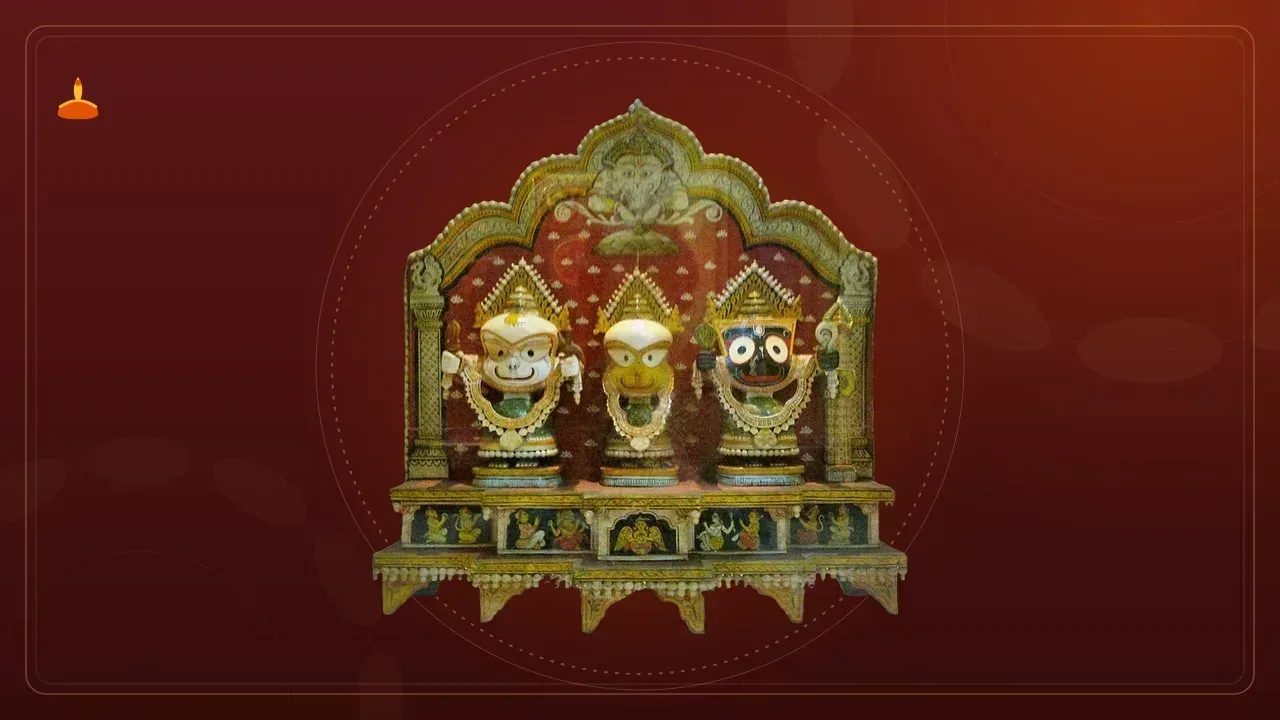
Those who cannot travel to Puri install a pattachitra or a wooden Jagannath-Balabhadra-Subhadra image at home. In the Puri pattachitra tradition all three deities are painted on a single panel — considered the most authentic form for a home shrine.
The samagri is simple: tulsi dal (tulsi is dearest to Jagannath), betel leaves, areca nut, coconut, banana and seasonal fruit, khaja (Puri's prasad), sandal, kumkum, ghee diyas and a small chhatra and flag.
- A Jagannath-Balabhadra-Subhadra idol, pattachitra or wooden image
- New cloth (a different colour for each deity), a small canopy, flag and chakra
- Tulsi dal, betel leaves, areca nut, coconut, banana, seasonal fruit
- Khaja and poda pitha (Puri's traditional prasad), jaggery, sugar
- Sandal, kumkum, turmeric, ghee diyas, incense, camphor
- A small chariot (wooden or paper) — decorating one with children is part of the tradition
Ahmedabad: the old city's 140-year-old yatra
After Puri, Ahmedabad's yatra is counted among India's largest, setting out from the Jamalpur Jagannath Temple and winding through the old city's lanes. The tradition dates back to the 19th century and is regarded as a symbol of the city's communal harmony.
Ahmedabad's yatra includes elephants and camels, akhadas, drums and decorated chariots. The crowds are very large, so routes are changed and there is extensive police arrangements.
- Ahmedabad: begins at the Jamalpur Jagannath Temple and passes through the old city
- Elsewhere in Gujarat: Jagannath Rath Yatras also set out in Vadodara, Surat and Rajkot
- Khaja and Puri-style prasad are widely available in Ahmedabad's sweet shops
Kolkata, Mahesh and the Bengali tradition
Bengal has a Rath Yatra tradition of its own, and the oldest of them is considered to be the yatra at Mahesh in Serampore — often called the birthplace of the Rath Yatra in Bengal. In Kolkata the ISKCON Rath Yatra sets out from the Maidan and draws large numbers of devotees.
Bengal also keeps the "Ulto Rath" tradition — the return journey of the chariot, celebrated as a separate festival. Centuries-old neighbourhood yatras also set out in Guptipara, Mahesh and other areas.
- Mahesh (Serampore): the oldest Rath Yatra tradition in Bengal
- Kolkata: the ISKCON Rath Yatra from the Maidan, and Ulto Rath the following week
- Guptipara and north Kolkata: older, neighbourhood-based yatras
- South India and elsewhere: ISKCON centre yatras in Bengaluru, Vrindavan, Delhi and Hyderabad
Nabakalebara: when Jagannath's body is renewed
A singular tradition attached to the yatra is Nabakalebara — the carving of new wooden images of Jagannath, Balabhadra, Subhadra and Sudarshana. It happens every 12 to 19 years, in a year when Ashadh carries two full moons, that is, an intercalary month.
In a Nabakalebara year the Rath Yatra is even more elaborate. The old images are cremated after Niladri Bije — the whole process is treated as deeply sacred and private.
Rath Yatra samagri and preparing for the yatra
The full samagri for the home puja — image, new cloth, tulsi dal, betel and areca nut, canopy and flag, khaja and ghee diyas — is listed with quantities in our Jagannath Rath Yatra samagri list.
For the related Krishna festivals, see the Janmashtami samagri list and the Radha Ashtami samagri list. Check auspicious timings with the Muhurat Finder and estimate costs with the budget calculator.
Frequently Asked Questions
When is Rath Yatra 2026?
Rath Yatra sets out on the dwitiya of the waxing moon in Ashadh, so the date shifts each year — usually between late June and mid-July. The Bahuda Yatra, the return journey, is nine days later.
What are the names of the three Rath Yatra chariots?
Nandighosa (Jagannath, the tallest), Taladhwaja (Balabhadra) and Darpadalana or Devadalana (Subhadra). Each has a different colour, charioteer and height.
What is Chhera Pahara?
In Chhera Pahara the Gajapati king sweeps the three chariots with a golden broom. It symbolises that even a king is a servant before God, and is considered the most symbolic ritual of the Rath Yatra.
Can Rath Yatra be celebrated at home?
Yes. A Jagannath-Balabhadra-Subhadra pattachitra or wooden image is installed at home and worshipped with tulsi dal, betel and areca nut, khaja, coconut and ghee diyas, along with a small decorated chariot.
Why is tulsi offered in Rath Yatra?
Tulsi dal is considered dearest to Jagannath. In the Puri tradition the offering is incomplete without tulsi, so it is essential both in the Rath Yatra and in the home puja.
Where does the Ahmedabad Rath Yatra begin?
The Ahmedabad Rath Yatra begins at the Jamalpur Jagannath Temple and passes through the lanes of the old city. The tradition dates to the 19th century and is among India's largest Rath Yatras.
What is Nabakalebara?
Nabakalebara is the tradition in which new wooden images of Jagannath, Balabhadra, Subhadra and Sudarshana are carved. It happens every 12 to 19 years, and the Rath Yatra is especially elaborate that year.